Sunday, 25 May 2014

Forthcoming Fieldwork 2014

The data collected in summer and autumn have been analysed during the first months of 2014. Interesting (although preliminary) results are now available. Particular attention was given to the intra-site analysis of the two huts in the Val Maudagna (Italy). The detailed study of spatial patterns of objects inside these structures and the analysis of soil samples gave significant insights for archaeological interpretation of seasonal sites and of alpine sites in particular. Besides, historical documents, ethno-historical references and the data recorded during the landscape surveys in Val Maudagna (Italy) and Vallee de Freissinieres (France), opened new perspectives for the study of historical mountain alpine landscapes. These perspectives will be the main focus of the next fieldwork campaign.
Two pastoral huts of Val Maudagna during the topographic survey
The 2014 fieldwork campaign of the EthWAL project will start in few weeks time. New archaeological surveys will be carried out, in order to identify and record new structures in the two study areas. Local farmers and herders will be interviewed, in order to learn something more about the exploitation of the mountain environment during the last century. Furthermore, shovel-tests will be undertaken inside sample structures. The aim of these excavations will be: 1) understanding the function of these sites and whether (and how) this function changed in time; 2) identifying when these structures were built; 3) identifying when these structures were abandoned (and possibly why).
One of the sample sites selected in the Vallee de Freissinieres (France)
Updates regarding the different phases of the forthcoming fieldwork campaign will be posted in this blog. Remarks, questions, doubts, suggestion are warmly welcomed!!

Sunday, 9 February 2014

Managing Fieldwork Data 3

The elaboration of the data collected during the summer fieldwork is going on.

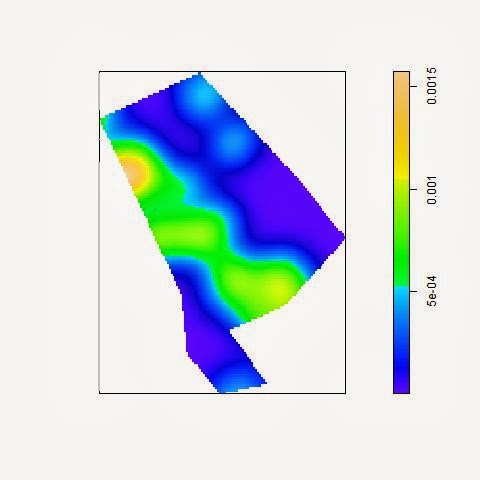
Geostatistical methods have been applied to the intrasite spatial data of the seasonal dry-stone huts of the Val della Brignola (Val Maudagna, Cuneo province, Italy). They provided interesting results, that will help to understand whether or not the distribution of artifacts and ecofacts mirrors the actual spatial behaviour of herders that used (and still use) these structures. The first results and the preliminary interpretations will be presented in a seminar at the end of this month.


 Density maps (kernel intensity surface, 30 cm sd) of artifacts/ecofacts distribution on the internal surfaces of two huts of the Val della Brignola (Val Maudagna, Cuneo province, Italy)


The study of documents collected in French and Italian historical archives enabled to know something more about the exploitation of the alpine pastures in the Modern Age, and to find interesting information about the construction, the management and the use of alpine seasonal structures in the 18th and 19th century. The transformations occurred in the landscapes of the western Alps during the last three centuries have been related to the transition from the "old regime" to the contemporary socio-economical framework.

Besides, the analysis of the soil samples collected within the aforementioned huts has just begun.

Saturday, 14 December 2013

Managing Fieldwork Data 2

In these autumn and winter months the EthWAL project is focused on managing the data collected during the summer fieldwork.
The locations of the recorded sites (both in the Vallée de Freissinières and Val Maudagna) have been linked to their attributes (dimension, preservation, etc.), and these data have been managed with two different GIS softwares: QGIS 1.8/GRASS 6.4 and ArchGIS 10. The interaction between the geographical position of sites and their carachteristics will enable to identify hidden patterns, that will shed new light on modern/current spatial strategies in the uplands. Interesting issues, for instance, are the process of abandonment of these sites, and the clustering/dispersion of sites in relation to their structural characteristics (dimension, shape, etc.).
The data collected during the topographic survey of three sites (pastoral huts) of Val Maudagna have been processed, with the fundamental collaboration of Federico Panighel. The second step will be the spatial analysis of artefacts scattered all over the internal surface of these sites. This analysis has just started, and it is carried out using R 3.0.2. The results will be useful to identify intra-site patterns suggesting activity areas and mobility within the huts (according to their function, dimension and forniture).


Two phases of the topographic survey in Val Maudagna (Cuneo province, Italy)

Tuesday, 15 October 2013

Managing fieldwork data

The fieldwork activities are finished in September, and this month was essentially dedicated to the management of fieldwork data. The locations of upland structures, recorded using an handheld GPS, have been elaborated and included into a GIS platform. Photographs and information about these sites have been sorted. The transcription of ethnographic interviews and historical documents has started too. The next step will be the management of data collected during the topographic survey of dry-stone huts in the Val Maudagna.

Topographic survey of a casòt near the Brignola lakes (Val Maudagna, Cuneo province, Italy)

Abandoned dry-stone hut near the Fangeas lake (Val de Freissiniéres, Dept. des Hautes-Alpes, France)


Tuesday, 17 September 2013

Fielwork 3


Last fieldwork campaing

The last fieldwork activities of 2013 have been carried out during the second week of September.

In the library of the Municipality of Freissiniéres I found several books about the exploitation of upland pastures in the valley of Freissiniéres during the 19th and 20th century (I thank Odile Segond for her precious help).

With the collaboration of Catherine Briotet, I found important historical documents (18th, 19th, 20th century) in the Archives Dipartimentales des Hautes-Alpes (Gap). They were related to the use of mountain areas for pastoral activities and hay-making during the modern age. Some interesting maps were documented too.

Field survey in Val Maudagna, aimed at recording abandoned dry-stone structures (casòt and selle), closed the fieldwork activities of summer 2013. It enabled to document (almost) all the seasonal rural structures that are located in the upland area around "La Balma" refuge.


A huge quantity of data has been collected in the last three months in the Val de Freissiniéres and Val Maudagna: spatial data on the landscape distribution and structure of upland sites; soil samples; historical documents and references; oral information from local herders and farmers. These data will be analysed and combined in the next months. New posts will concern the first results of these analyses.


Two casòt recently abandoned in Val Maudagna. These are traditional dry-stone huts that were "restored" few years ago using cement.


Tuesday, 27 August 2013

Fieldwork 2

Second Fieldwork Campaing

The second fieldwork campaing of the EthWAL project was carried out in July and August

The first phase took place in the Val Maudagna (Cuneo province, Italy). With the help of Giovanni Comino (major of Frabosa Sottana), Gianni Dulbecco (www.frabosasottana.com) and the two veterinaries Gian Piero Rinaudo and Irma Bovolo (ASL Mondovì), I visited the pastures around Prato Nevoso and Artesina and I started to record all the pastoral structures in the upland landscape (using an handheld GPS). Several structures have been identified and recorded, and they have been divided in two categories: huts (casòt in the local dialect) where the herders (marghé) live during the summer and produce cheese; cellars (selle) where the herders stock the cheese for maturing. Some of these structures are still exploited by herders during the summer.


Two huts (casòt) near the Brignola lake (Val Maudagna, Cuneo province, Italy)


Cellar (sella) in the Val Brignola (Val Maudagna, Cuneo province, Italy)

Some herders have been interviewed during this research period, and they provided fundamental information for the comprehension of pastoral upland management and traditional rural structures and landscapes. Interesting data about traditional cheese making, building techniques and spatial patterns have also been collected. Besides, the veterinary office of Mondovì provided important documents related to milk exploitation and processing.

The second phase has been carried out in the Vallée de Freissiniéres. Using a handheld GPS, several seasonal structures have been recorded in different upland areas of the valley (Faravel, Pont de Fer, Fangeas, etc.). These structures are mainly dry-stone huts, but rock-shelters and enclosures have also been identified and recorded. All these structures have been used in recent periods (18th, 19th, 20th century), but none is still used nowadays. In order to understand how they were built, exploited and abandoned, I interviewed (with the precious help of Laura Fossati) some retired herders and farmers that still live in the valley. The information provided by these herders and farmers were significant for correlating the use and abandonment of the recorded structures with the evolution of upland management in this valley. Furthermore, some old pubblications concerning the economic activities of this area seem to confirm the information obtained from the interviews. Four different strategies have been identified for the late 19th and early 20th century: short transhumance of dairying cattle; short transhumance of non-dairying sheep and goats; long transhumance of non-dairying sheep and goats; hay-making. In the 21st century only short and long transhumance of non-dairying sheep and goats is still undertaken.


Dry-stone hut built under a rock-shelter (Fangeas, Vallée de Freissinieres, Dept. des Hautes-Alpes, France)

Dry-stone hut near the Fangeas lake (Vallée de Freissinieres, Dept. des Hautes-Alpes, France)

The third and last phase has been the topographic survey of some huts (casot) still exploited by the herders in the high altitudes of Val Maudagna. Four structures have been selected in the Val della Brignola, a small upland valley. The herder that still exploits this grazing area has been interviewed, in order to know exactly how the huts are used and managed. With the help of Federico Panighel, a student of civil engineering at the University of Trieste (Italy), the selected structures have been surveyed using a total station. The walls and the internal spatial organisation (furnitures, heart, etc.) have been surveyed, and the dispersion of material culture within the huts have been mapped too, in order to enable specific spatial analysis and to investigate the relationships between activities and archaeological record within seasonal sites. Soil samples have also been taken inside the surveyed huts, and other huts and cellars have been positioned using an handheld GPS.


Topographical survey of a hut (casòt)

Federico, the total station and me!

The next phases will be the analysis and interpretation of all the collected data. Historical archives and libraries will be also visited, in order to acquire further historical information about the studied area and the recorded structures.

The last fieldwork activities will be carried out in September. The next update will be online at the end of next month!

Sunday, 7 July 2013

Fieldwork 01

First fieldwork campaing

The first fieldwork campaing of the EthWAL project was carried out in June 2013

The first part of the research took place in the Monregalese area (Cuneo province, Italy). The activities focused on the small Municipality of Frabosa Sottana, that corresponds to the entire territory of Val Maudagna (see the photo below).


With the precious help of Giovanni Comino, mayor of Frabosa Sottana, I had the opportunity to consult the local historical archive, to meet and interview some shepherds and to know better the study area. I have also acquired some digital cartography (thanks to Gianni Siletto, of the Regione Piemonte) and I have heard of interesting studies on rural landscapes that have been carried out in other mountain areas of the Piemonte Region (thanks to Diego Mondo, of the Regione Piemonte).

The second part of my research took place in the Parc National des Ecrins. In order to understand the current and traditional pastoral strategies in this area, I went to the Maison du Berger, a museum and documentation center for alpine transhumance located in the small village of Champoleon (http://www.maisonduberger.fr/). I consulted the library of the museum, and the director, Guillaume Lebaudy, explained me the shepherds' lifestyle  in the French Hautes-Alpes.

Afterwards, I went to the library of the Parc National des Ecrins in Gap (Dept. des Hautes-Alpes), where I had the opportunity to read papers and dossiers that dealt with pastoralism in the Ecrins territory.

After this preliminary phase of research in the French Alps, I decided to select as sample area the high Vallée de Freissiniéres, placed in the Briançonais, in the eastern part of the Parc National des Ecrins (see photo below):


In July the second part of the fieldwork will take place. After selecting the study areas and understanding local pastoral strategies (in the recent past as well as nowadays), I am ready to start the proper fieldwork with the shepherds in the high pastures.
Next update in August!